
- What Is IT Band Syndrome?
- Why Do Runners Get IT Band Pain?
- Early Signs You Should Not Ignore
- The Role of Hip Weakness in IT Band Problems
- Common Running Mistakes That Cause IT Band Pain
- Running Form Issues Causing IT Band Pain
- Why Does My IT Band Hurt After Running?
- Why Downhill Running Often Triggers Symptoms
- How to Prevent IT Band Pain When Running
- Exercises to Prevent IT Band Syndrome
- Stretches for IT Band Pain Relief
- Treatment for IT Band Pain From Running
- How to Recover From IT Band Pain Quickly
- When Should Runners Seek Professional Help?
- The Bottom Line
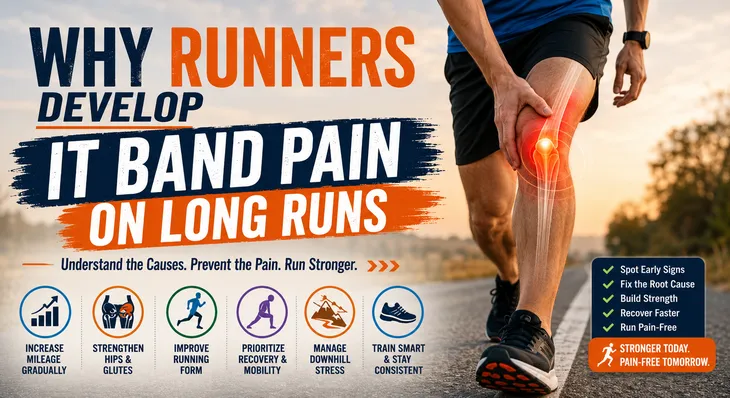
Why Runners Develop IT Band Pain on Long Runs Long-distance running places repetitive stress on the body. While many runners expect occasional muscle soreness, pain on the outside of the knee can be alarming. One of the most common causes is iliotibial band syndrome (ITBS), often referred to as IT band pain. If you've ever wondered why runners develop IT band pain on long runs, the answer usually involves a combination of training errors, muscle imbalances, biomechanics, and recovery issues. The condition can affect beginners training for their first 10K as well as experienced marathon runners logging high weekly mileage. Understanding the root causes can help you prevent long-term problems, recover faster, and continue running without discomfort.
What Is IT Band Syndrome?
The iliotibial (IT) band is a thick band of connective tissue that runs from the outer aspect of the hip to the outer aspect of the knee. It helps stabilize the knee and hip during movement, especially during running. IT band syndrome occurs when this tissue becomes irritated due to repetitive stress. The most common symptom is IT band pain on the outside of the knee, particularly during longer runs. Quick overview:
- The IT band supports knee stability.
- Repetitive running movements can irritate surrounding tissues.
- Pain usually develops gradually.
- Symptoms often worsen with increased mileage.
Among endurance athletes, it is one of the most common long-run injuries affecting the IT band.
Why Do Runners Get IT Band Pain?
The short answer is repetitive loading. During every running stride, the knee bends and straightens thousands of times. Over long distances, small movement inefficiencies can place excessive stress on the IT band. Common contributing factors include:
- Sudden mileage increases
- Weak hip muscles
- Poor running mechanics
- Insufficient recovery
- Downhill running
- Inadequate strength training
The causes of IT band syndrome in runners rarely involve a single issue. Instead, several factors often combine to create irritation over time.
Early Signs You Should Not Ignore
Recognizing the early signs of IT band syndrome in runners can prevent a minor issue from becoming a season-ending injury. Common warning signs include:
- Sharp pain on the outside of the knee
- Discomfort appears after several miles
- Pain that worsens as the run continues
- Tenderness when pressing the outer knee
- Tightness along the outside of the thigh
- Difficulty running downhill
Many runners notice outer knee pain during long runs but feel relatively normal while walking. This pattern is often an early indicator of ITBS.
Symptoms Frequently Seen in Marathon Training
IT band syndrome symptoms in marathon runners often appear during peak training periods when mileage and fatigue increase. These symptoms may include:
- Pain starts later in long runs
- Discomfort on stairs after running
- Tight hips and glutes
- Reduced running efficiency
- Lingering soreness after workouts
Ignoring these signs can allow the problem to worsen significantly.
The Role of Hip Weakness in IT Band Problems
One of the biggest contributors to hip weakness and IT band pain in runners is poor glute strength. The glute muscles help control leg alignment during running. When they become weak or fatigued, the knee may drift inward excessively with each step. This altered movement pattern increases stress on the tissues surrounding the IT band. Research and clinical experience consistently show that runners with ITBS often demonstrate weakness in:
- Gluteus medius
- Gluteus maximus
- Deep hip stabilizers
Improving hip strength is often one of the most effective long-term solutions.
Signs Your Hips May Be Contributing
You may have hip-related IT band issues if you notice:
- Knee collapse during squats
- Pelvic drop while running
- Difficulty balancing on one leg
- Excessive fatigue in the hips during long runs
Addressing these weaknesses often reduces symptoms significantly.
Common Running Mistakes That Cause IT Band Pain
Training mistakes frequently trigger IT band problems. Some of the most common running mistakes that cause IT band pain include:
Increasing Mileage Too Quickly
A sudden jump in weekly volume gives tissues little time to adapt. A safer approach is increasing mileage gradually while monitoring recovery.
Running Every Workout Hard
High-intensity sessions create additional stress on the knees and hips. Balancing hard and easy days helps reduce overload.
Skipping Strength Training
Many runners focus solely on mileage while neglecting strength work. Without adequate muscular support, the IT band may experience greater strain.
Ignoring Recovery
Recovery allows tissues to repair and adapt. Poor sleep, excessive training, and inadequate nutrition can increase the risk of injury.
Running Form Issues Causing IT Band Pain
Biomechanics can significantly influence IT band stress. Several running-form issues that cause IT band pain are commonly observed in injured runners. These include:
- Excessive overstriding
- Low cadence
- Excessive crossover gait
- Poor pelvic stability
- Excessive trunk lean
Why Cadence Matters
A slightly higher cadence often reduces stress on the knee and hip. Many coaches recommend increasing cadence by approximately 5-10% when appropriate. Benefits may include:
- Shorter ground contact time
- Reduced braking forces
- Better running efficiency
- Lower knee stress
Small form improvements can make a substantial difference over long distances.
Why Does My IT Band Hurt After Running?
Many runners ask, "Why does my IT band hurt after running when it felt okay during the workout?" Several explanations exist:
- Inflammation becomes more noticeable after activity.
- Muscles fatigue toward the end of the run.
- Tight tissues stiffen during recovery.
- Microscopic tissue irritation accumulates over time.
Iliotibial band pain after long runs often becomes more obvious several hours later, especially when sitting, climbing stairs, or getting up after prolonged inactivity. This delayed discomfort is common and should not be ignored.
Why Downhill Running Often Triggers Symptoms
IT band pain when running downhill is extremely common. Downhill running increases braking forces and requires greater control from the hips and quadriceps. As the knee bends repeatedly under load, stress on the outer knee structures rises. Runners frequently notice:
- Pain begins during descents
- Increased discomfort on hilly routes
- Symptoms appearing earlier than normal
If downhill sections consistently trigger symptoms, reducing hill volume temporarily may help during recovery.
How to Prevent IT Band Pain When Running
Prevention is far easier than treatment. If you want to know how to prevent IT band pain when running, focus on building resilience before symptoms appear.
Key Prevention Strategies
- Increase mileage gradually.
- Strength train twice weekly.
- Improve running mechanics.
- Prioritize recovery.
- Avoid excessive downhill volume.
- Replace worn-out shoes when necessary.
Weekly Habits That Help
- Mobility work after runs
- Hip strengthening exercises
- Dynamic warm-ups
- Adequate hydration
- Consistent sleep
Combining these habits significantly lowers injury risk.
Exercises to Prevent IT Band Syndrome
Targeted strength training helps address many underlying causes. Some of the best exercises to prevent IT band syndrome include:
Side-Lying Leg Raises
Benefits:
- Strengthens hip stabilizers
- Improves pelvic control
- Supports knee alignment
Clamshells
Benefits:
- Activates the gluteus medius
- Improves hip stability
- Reduces excessive knee movement
Single-Leg Deadlifts
Benefits:
- Enhances balance
- Improves hip strength
- Builds running-specific stability
Step-Ups
Benefits:
- Mimics running mechanics
- Develops leg strength
- Improves control during fatigue
Performing these exercises consistently is often more effective than relying solely on stretching.
Stretches for IT Band Pain Relief
Although the IT band itself is difficult to stretch significantly, surrounding muscles can become tight and contribute to symptoms. Useful stretches for IT band pain relief include:
Standing IT Band Stretch
Targets:
- Outer hip
- Lateral thigh
Figure-Four Stretch
Targets:
- Glutes
- Deep hip rotators
Hip Flexor Stretch
Targets:
- Front of the hip
- Pelvic positioning
Quadriceps Stretch
Targets:
- Front thigh muscles
- Knee movement mechanics
Hold each stretch for 20-30 seconds and avoid forcing painful positions.
Treatment for IT Band Pain From Running
When symptoms develop, early management often produces the best outcomes. Effective treatment for IT band pain from running may include:
Temporary Activity Modification
You do not always need complete rest. Instead:
- Reduce mileage
- Avoid aggravating hills
- Substitute some runs with cycling or swimming if tolerated
Strength Rehabilitation
Focus on:
- Glute strengthening
- Hip stabilization
- Single-leg control exercises
Mobility Work
Address tightness in:
- Hip flexors
- Glutes
- Quadriceps
Professional Assessment
Persistent symptoms may require evaluation from a physiotherapist or sports medicine professional. An expert can identify biomechanical issues that may not be obvious.
How to Recover From IT Band Pain Quickly
Runners naturally want to know how to recover from IT band pain quickly. While there is no instant fix, recovery can be accelerated by addressing root causes. Recovery priorities include:
- Reducing aggravating activities
- Maintaining aerobic fitness through cross-training
- Following a structured strengthening program
- Improving sleep quality
- Returning to running gradually
A common mistake is resuming full mileage immediately after symptoms improve. Gradual progression reduces the risk of recurrence.
Sample Return-to-Running Approach
Week 1:
- Short, easy runs
- Flat terrain only
Week 2:
- Slight mileage increase
- Continue strength training
Week 3:
- Reintroduce moderate long runs
Week 4:
- Gradually resume normal training if symptom-free
Patience during recovery often leads to better long-term outcomes.
When Should Runners Seek Professional Help?
Consider professional evaluation if:
- Pain persists for several weeks
- Symptoms worsen despite rest
- Running becomes impossible
- Knee swelling develops
- Daily activities become painful
Early intervention can prevent chronic issues and shorten recovery time.
The Bottom Line
Understanding why runners develop IT band pain on long runs starts with recognizing that the condition is usually caused by a combination of repetitive stress, training errors, muscle weakness, and movement inefficiencies. Whether you're experiencing IT band pain during long-distance running, dealing with outer knee pain while running long distances, or wondering why your IT band hurts after running, addressing the underlying factors is essential. Most runners can successfully overcome IT band syndrome through gradual training progression, improved running mechanics, targeted strengthening exercises, and proper recovery habits. By paying attention to early warning signs and correcting common mistakes, you can reduce injury risk and continue enjoying pain-free running for years to come.