
- Quick Answer: What Happens to Your Spine When You Sit Too Much?
- Why Sitting Places More Stress on the Spine Than Standing
- How Sitting Affects Spinal Discs
- Sitting All Day and Lower Back Pain: Why It Happens
- Posture Changes From Prolonged Sitting
- How Desk Jobs Affect the Spine Over Time
- Work From Home Sitting and Back Pain: A Growing Concern
- Can Sitting Too Long Damage Your Spine?
- Spinal Problems Caused by Prolonged Sitting
- Signs Your Spine Is Being Affected by Too Much Sitting
- Health Risks of Sitting All Day Beyond the Spine
- How to Protect Your Spine While Sitting
- Exercises to Reverse the Effects of Sitting
- A Simple Daily Routine for Desk Workers
- When Sitting-Related Back Pain Needs Medical Attention
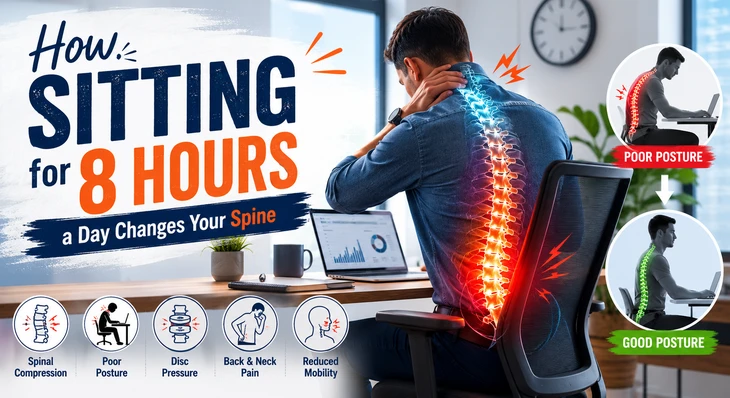
How Sitting for 8 Hours a Day Changes Your Spine Most modern jobs require long hours at a desk. Whether you work in an office, study for extended periods, or spend your day working from home, sitting has become a major part of daily life. While sitting may seem harmless, many people are surprised to learn that prolonged sitting can gradually affect spinal health, posture, mobility, and overall comfort. If you've ever experienced lower back stiffness after prolonged sitting, neck tension, or discomfort when standing up after hours at a desk, your spine may already be responding to the effects of inactivity. Understanding how sitting for 8 hours a day changes your spine can help you make better choices and prevent long-term problems before they become serious.
Quick Answer: What Happens to Your Spine When You Sit Too Much?
When you sit for long periods:
- Pressure on spinal discs increases.
- Core and back muscles become weaker.
- Hip flexor muscles tighten.
- Posture gradually deteriorates.
- Natural spinal curves may become altered.
- Blood circulation decreases.
- The risk of chronic neck and lower back pain increases.
Over time, the effects of sitting for 8 hours a day on the spine can contribute to discomfort, reduced mobility, and certain degenerative spinal conditions.
Why Sitting Places More Stress on the Spine Than Standing
Many people assume sitting is a resting position for the spine. In reality, sitting often places more pressure on spinal structures than standing. The human spine is designed for movement. Walking, standing, bending, and changing positions help distribute forces evenly across vertebrae, muscles, ligaments, and discs. When you remain seated for hours:
- Lumbar discs experience increased compression.
- Back muscles remain under constant low-level tension.
- Hip muscles shorten.
- The pelvis often tilts backward.
- The head moves forward toward the screens.
This causes spinal compression from prolonged sitting and increases mechanical stress throughout the back.
How Sitting Affects Spinal Discs
Spinal discs act as cushions between vertebrae. They absorb shock and allow flexibility during movement.
Increased Disc Pressure
Research has shown that sitting can increase pressure within spinal discs compared to standing. As pressure builds:
- Discs lose fluid throughout the day.
- Disc nutrition decreases.
- Shock absorption becomes less effective.
- Disc degeneration may accelerate over time.
This explains why many people experience lower back pain from sitting all day.
Reduced Nutrient Exchange
Unlike muscles, spinal discs have a limited blood supply. They depend on movement to exchange nutrients and remove waste products. When movement is restricted for hours:
- Disc hydration decreases.
- Nutrient flow slows.
- Recovery processes become less efficient.
Over the years, this may contribute to age-related spinal changes.
Sitting All Day and Lower Back Pain: Why It Happens
Lower back pain is one of the most common complaints among office workers and remote employees. Several factors contribute to sitting all day and lower back pain.
Muscle Fatigue
The muscles supporting the spine must continuously stabilize your posture. Over time:
- Muscles become fatigued.
- Small supporting muscles weaken.
- Spinal alignment becomes harder to maintain.
Poor Sitting Posture
Many people gradually slide forward in their chair, creating a rounded lower back. This position:
- Stretches spinal ligaments.
- Increases disc pressure.
- Strains surrounding muscles.
Tight Hips
Sitting shortens the hip flexor muscles located at the front of the hips. Tight hip flexors can:
- Pull the pelvis forward.
- Alter spinal alignment.
- Increase stress on the lumbar spine.
These factors explain why long hours of sitting cause back problems is such a common issue.
Posture Changes From Prolonged Sitting
One of the most noticeable effects of prolonged sitting is gradual deterioration in posture.
Forward Head Posture
Many people lean toward their screens without realizing it. For every inch the head moves forward:
- Neck muscles work harder.
- Upper back strain increases.
- Shoulder tension develops.
Rounded Shoulders
Desk work often encourages:
- Slouched shoulders
- Tight chest muscles
- Weak upper back muscles
This posture can contribute to neck pain, shoulder discomfort, and headaches.
Flattened Lumbar Curve
The lower back naturally has a gentle inward curve. Extended sitting often reduces this curve, increasing stress on spinal structures and contributing to poor posture and spine health issues.
How Desk Jobs Affect the Spine Over Time
Desk jobs may not seem physically demanding, but years of sitting can significantly influence musculoskeletal health. Common spinal effects include:
- Chronic lower back pain
- Neck stiffness
- Reduced spinal mobility
- Disc degeneration
- Muscle imbalances
- Increased risk of postural disorders
How desk jobs affect the spine depends on factors such as posture, workstation setup, activity levels, and exercise habits outside of work.
Work From Home Sitting and Back Pain: A Growing Concern
Remote work has increased dramatically in recent years. Unfortunately, many home workspaces are not designed with ergonomics in mind. Common problems include:
- Working from couches
- Using dining chairs for long hours
- Laptop screens positioned too low
- Lack of lumbar support
As a result, work from home sitting and back pain have become increasingly common. Small workstation improvements can significantly reduce spinal strain.
Can Sitting Too Long Damage Your Spine?
Many people ask whether sitting itself causes permanent damage.
The Short Answer
Sitting alone does not automatically damage the spine. However, sitting excessively without movement can contribute to:
- Accelerated disc wear
- Chronic muscle imbalance
- Postural dysfunction
- Persistent pain conditions
The greater risk comes from remaining in the same position for extended periods day after day. This is why experts emphasize regular movement breaks rather than eliminating sitting altogether.
Spinal Problems Caused by Prolonged Sitting
Over time, prolonged sitting may contribute to several spinal issues.
Degenerative Disc Changes
Reduced movement and ongoing disc compression may accelerate natural age-related wear.
Chronic Muscle Imbalances
Some muscles become tight while others weaken. Common examples include:
- Tight hip flexors
- Tight chest muscles
- Weak gluteal muscles
- Weak core muscles
Facet Joint Irritation
Small joints in the spine can become irritated when posture remains poor for long periods.
Persistent Mechanical Back Pain
Mechanical back pain develops when muscles, joints, and connective tissues are repeatedly stressed. These are among the most common spinal problems caused by prolonged sitting.
Signs Your Spine Is Being Affected by Too Much Sitting
Early warning signs often appear before major problems develop. Watch for:
- Lower back stiffness from prolonged sitting
- Neck tightness
- Frequent posture slouching
- Mid-back discomfort
- Hip tightness
- Difficulty standing upright after sitting
- Pain that improves with movement
- Reduced flexibility
Recognizing these symptoms early allows you to make corrections before chronic issues develop.
Health Risks of Sitting All Day Beyond the Spine
Although spinal health is a major concern, sitting affects the entire body. Research links prolonged inactivity to:
- Reduced circulation
- Increased risk of obesity
- Higher risk of cardiovascular disease
- Poor metabolic health
- Reduced energy levels
- Muscle weakness
The health risks of sitting all day extend well beyond back pain. This is why movement throughout the day is so important.
How to Protect Your Spine While Sitting
You do not need to quit your desk job to maintain a healthy spine. Simple habits can make a significant difference.
Adjust Your Workstation
Aim for:
- Screen at eye level
- Feet flat on the floor
- Knees at approximately 90 degrees
- Elbows supported near desk height
- Lower back supported
Change Positions Frequently
The best posture is often the next posture. Try to:
- Stand every 30–60 minutes
- Walk briefly during breaks
- Alternate positions regularly
Use a Supportive Chair
A quality chair should support:
- Natural lumbar curve
- Proper hip positioning
- Balanced weight distribution
These strategies are among the most effective ways to protect your spine while sitting.
Exercises to Reverse the Effects of Sitting
Regular movement helps counteract many negative effects of prolonged sitting.
1. Hip Flexor Stretch
Benefits:
- Reduces hip tightness
- Improves pelvic alignment
- Decreases lower back strain
2. Cat-Camel Stretch
Benefits:
- Improves spinal mobility
- Reduces stiffness
- Encourages healthy movement
3. Glute Bridges
Benefits:
- Strengthens gluteal muscles
- Supports the lower back
- Improves posture
4. Thoracic Extensions
Benefits:
- Opens the chest
- Reduces rounded shoulders
- Improves upper back mobility
5. Walking Breaks
One of the simplest solutions is regular walking. Even a 5-minute walk every hour can:
- Improve circulation
- Reduce spinal compression
- Decrease muscle stiffness
These are some of the most effective exercises to reverse the effects of sitting.
A Simple Daily Routine for Desk Workers
To maintain spinal health: Morning:
- 5 minutes of stretching
- Short walk before work
During Work:
- Stand every 30–60 minutes
- Walk during phone calls
- Perform quick posture checks
After Work:
- 20–30 minutes of physical activity
- Mobility exercises
- Core strengthening exercises
Consistency matters more than intensity. Small daily actions often provide better long-term results than occasional workouts.
When Sitting-Related Back Pain Needs Medical Attention
Most sitting-related discomfort improves with movement, posture changes, and exercise. However, some symptoms require professional evaluation. Seek medical attention if you experience:
- Pain lasting several weeks
- Progressive worsening of symptoms
- Leg numbness or tingling
- Muscle weakness
- Difficulty walking
- Loss of bladder or bowel control
- Severe pain that interrupts sleep
Knowing when sitting-related back pain needs medical attention is important because certain symptoms may indicate nerve involvement or more significant spinal conditions.
Small Daily Habits Make a Big Difference
Understanding how sitting for 8 hours a day changes your spine highlights an important reality: the spine thrives on movement. While sitting is an unavoidable part of modern life, remaining in one position for hours creates stress on spinal discs, muscles, joints, and posture. The good news is that most of these effects can be minimized through regular movement, proper workstation setup, posture awareness, and targeted exercises. By taking short breaks, strengthening supporting muscles, and maintaining good spinal habits, you can reduce back pain from sitting all day and protect your spinal health for years to come. The goal is not to avoid sitting completely—it is to avoid staying still for too long. Your spine was designed to move, and giving it regular opportunities to do so is one of the best investments you can make in your long-term health.