
- Quick Answer: Why Does Knee Pain Happen on Stairs but Not While Walking?
- Why Stairs Put More Stress on Your Knees
- Patellofemoral Pain Syndrome: The Most Common Cause
- Could Chondromalacia Patella Be Causing the Pain?
- Can Arthritis Cause Pain Only on Stairs?
- Meniscus Injuries and Stair Climbing Pain
- Why Sharp Knee Pain Happens While Going Up Stairs
- Knee Pain When Bending and Climbing Stairs
- Muscle Weakness and Poor Knee Mechanics
- Why Going Down Stairs May Hurt More
- How Doctors Diagnose Stair-Related Knee Pain
- How to Relieve Knee Pain When Climbing Stairs
- Best Exercises for Stair-Related Knee Pain
- Common Mistakes That Make Stair Pain Worse
- When to See a Doctor for Knee Pain on Stairs
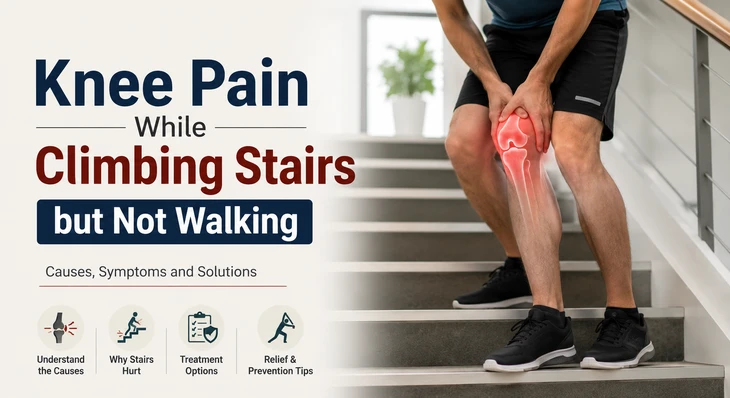
Many people experience knee pain when climbing stairs but not when walking, which can be confusing. Walking on flat ground may feel completely normal, yet the moment you start climbing a staircase, discomfort appears around or behind the kneecap. This pattern of pain is often linked to conditions affecting the kneecap, cartilage, tendons, or joint mechanics. Because climbing stairs places significantly more pressure on the knee joint than level walking, underlying problems often become noticeable only during stair use. If you've been wondering, "Why does my knee hurt when climbing stairs but not walking?", the answer usually lies in how forces are distributed through the knee during different movements. Understanding the possible causes can help you manage symptoms, prevent worsening damage, and know when professional evaluation is necessary.
Quick Answer: Why Does Knee Pain Happen on Stairs but Not While Walking?
During normal walking, the knee experiences relatively moderate stress. When climbing stairs:
- The knee bends more deeply.
- The quadriceps muscles work harder.
- The kneecap presses more firmly against the thigh bone.
- Joint forces increase significantly.
As a result, conditions that may not cause pain during level walking can become painful when using stairs. Common causes include:
- Patellofemoral pain syndrome
- Chondromalacia patella
- Early arthritis
- Meniscus injuries
- Tendon irritation
- Muscle weakness or imbalance
- Poor kneecap tracking
Why Stairs Put More Stress on Your Knees
Many people experience knee pain going up stairs, but not on flat ground, because stair climbing requires greater knee flexion.Research has shown that stair climbing can place several times your body weight through the knee joint. When climbing stairs:
- The knee bends further.
- The quadriceps contract forcefully.
- The kneecap is pressed into the groove of the femur.
- Cartilage experiences increased loading.
If any structure within the knee is irritated or damaged, stair climbing often becomes painful before regular walking does.
Patellofemoral Pain Syndrome: The Most Common Cause
One of the most common reasons for pain in the knee when walking upstairs is patellofemoral pain syndrome, stairs discomfort.This condition develops when the kneecap and thigh bone do not move smoothly together.
Typical symptoms
- Pain around or behind the kneecap
- Discomfort when climbing stairs
- Pain after prolonged sitting
- Grinding sensations
- Mild swelling
Many people describe:
- front knee pain when climbing stairs
- pain around the kneecap when using stairs
- aching that improves with rest
Patellofemoral pain syndrome is especially common among:
- Runners
- Athletes
- Office workers
- Teenagers
- Young adults
This explains why knee pain while climbing stairs in young adults is frequently linked to kneecap tracking problems.
Could Chondromalacia Patella Be Causing the Pain?
Another common diagnosis is chondromalacia patella, causing stair pain. Chondromalacia occurs when the cartilage beneath the kneecap softens, becomes irritated, or wears down.
Common signs
- Dull ache in the front of the knee
- Cracking or grinding sounds
- Pain when squatting
- Pain while using stairs
- Discomfort after sitting for long periods
Because stair climbing compresses the kneecap against the thigh bone, symptoms often become particularly noticeable during stair use. People frequently report:
- knee pain when using stairs but not walking
- discomfort during deep knee bends
- pain when standing from a chair
Can Arthritis Cause Pain Only on Stairs?
Yes. Although advanced arthritis often causes pain during most activities, early arthritis may initially appear only during demanding movements.
Signs of arthritis-related stair pain
- Morning stiffness
- Mild swelling
- Reduced flexibility
- Clicking sensations
- Gradually worsening symptoms
As cartilage wears down, stair climbing usually becomes increasingly difficult.
Meniscus Injuries and Stair Climbing Pain
The meniscus acts as a shock absorber inside the knee. A tear can cause pain during movements that involve bending and twisting.
Symptoms suggesting a meniscus injury
- Joint line tenderness
- Catching sensations
- Locking of the knee
- Swelling
- Instability
People with a torn meniscus often notice meniscus injury and stair-climbing pain, especially while descending stairs. Pain may be sharp, sudden, and localized to one side of the knee.
Why Sharp Knee Pain Happens While Going Up Stairs
Experiencing sharp knee pain while going up stairs can indicate:
- Patellofemoral irritation
- Meniscus injury
- Tendon inflammation
- Cartilage damage
- Joint inflammation
Sharp pain often occurs when a specific structure becomes compressed during knee bending. If the pain is sudden and severe, particularly after an injury, medical evaluation is recommended.
Knee Pain When Bending and Climbing Stairs
Many knee problems worsen whenever the joint bends deeply. This explains why some people develop knee pain when bending and climbing stairs, even though walking remains comfortable. Activities that commonly trigger symptoms include:
- Squatting
- Lunging
- Kneeling
- Stair climbing
- Getting up from low chairs
Deep knee flexion increases pressure within the joint, exposing underlying issues.
Muscle Weakness and Poor Knee Mechanics
Sometimes the knee itself is not the primary problem. Weak muscles around the hip and thigh can alter movement patterns and increase stress on the knee.
Muscles commonly involved
- Quadriceps
- Gluteus medius
- Hamstrings
- Core stabilizers
People with weak knees and pain when climbing stairs often improve significantly through strengthening exercises. Poor biomechanics may cause:
- Kneecap misalignment
- Excess joint loading
- Increased cartilage stress
- Recurrent stair-related discomfort
Why Going Down Stairs May Hurt More
Some people experience knee pain going down stairs and climbing stairs, while others feel pain primarily during descent. Descending stairs requires controlled eccentric muscle contraction. This increases pressure behind the kneecap and can aggravate:
- Patellofemoral pain syndrome
- Chondromalacia
- Arthritis
- Tendon irritation
Pain while going down stairs is often considered a classic sign of patellofemoral dysfunction.
How Doctors Diagnose Stair-Related Knee Pain
Diagnosis typically begins with a detailed medical history and physical examination. A healthcare provider may assess:
- Walking pattern
- Knee alignment
- Range of motion
- Strength
- Swelling
- Tenderness
Imaging may be recommended when necessary.
Possible tests
- X-rays
- MRI scans
- Ultrasound imaging
- Functional movement assessment
Accurate diagnosis is important because treatment varies depending on the underlying cause.
How to Relieve Knee Pain When Climbing Stairs
If you're searching for how to relieve knee pain when climbing stairs, several conservative treatments can help.
Reduce aggravating activities
Temporarily limit:
- Excessive stair climbing
- Deep squats
- Jumping
- High-impact exercise
Apply ice
Ice may reduce inflammation and discomfort. Use for:
- 15–20 minutes
- Several times daily
- Especially after the activity
Wear supportive footwear
Proper shoes can improve alignment and reduce knee stress.
Consider physical therapy
Physical therapy is one of the most effective long-term solutions for stair-related knee pain.
Best Exercises for Stair-Related Knee Pain
Strengthening the muscles surrounding the knee can improve function and reduce symptoms.
Helpful exercises
Straight leg raises
- Strengthen the quadriceps
- Minimize joint stress
Wall sits
- Improve endurance
- Support kneecap stability
Clamshells
- Strengthen hip muscles
- Improve knee alignment
Glute bridges
- Enhance lower-body stability
- Reduce knee strain
Step-ups
- Build functional strength
- Mimic daily movement patterns
Exercises should be performed under professional guidance if pain is significant.
Common Mistakes That Make Stair Pain Worse
Many people unintentionally worsen symptoms. Avoid:
- Ignoring persistent pain
- Exercising through sharp discomfort
- Poor exercise technique
- Wearing worn-out footwear
- Sudden increases in activity levels
- Delaying treatment after injury
Early intervention often leads to faster recovery and better outcomes.
When to See a Doctor for Knee Pain on Stairs
Understanding when to see a doctor for knee pain on stairs is important. Seek medical attention if you experience:
- Pain lasting more than a few weeks
- Significant swelling
- Knee locking
- Knee giving way
- Difficulty bearing weight
- Severe pain after injury
- Progressive worsening of symptoms
Prompt evaluation can help identify serious conditions before they become more difficult to treat.
What Recovery Typically Looks Like
Recovery depends on the underlying cause.
Patellofemoral pain syndrome
- Often improves within weeks to months
- Responds well to strengthening exercises
Chondromalacia patella
- May require longer rehabilitation
- Often improves with activity modification
Meniscus injuries
- Mild cases may heal conservatively
- Some tears require surgery
Arthritis
- Usually managed rather than cured
- Symptoms can often be controlled effectively
Consistent treatment and proper exercise play major roles in long-term improvement.
Key Takeaways
Experiencing knee pain while climbing stairs but not walking is a common complaint and often points to increased stress on the kneecap, cartilage, or surrounding structures rather than a major walking problem. The most common causes include:
- Patellofemoral pain syndrome
- Chondromalacia patella
- Early arthritis
- Meniscus injuries
- Muscle weakness and poor biomechanics
If symptoms are mild, strengthening exercises, activity modification, supportive footwear, and physical therapy often provide relief. However, persistent pain, swelling, instability, or locking should be evaluated by a healthcare professional. Understanding why your knee hurts when climbing stairs is the first step toward finding the right treatment and returning to pain-free movement.